In order to distribute mobile marine seismology (hereafter “SMM” for its French acronym) data to the
scientific community, these data and their associated metadata must be packaged in standard formats
and validated. The SMM A-Node helps instrumentation facilities and experiment scientists to work
together to deliver and validate these data.
The basic processing unit is a “Campaign”, which covers one cycle of data collection. Basic data and
meta data are prepared by the involved facilities, then sent to the A-Node A for further processing and
validation. After validation, the A-node sends the data and metadata to the Data Center.
This documentation provides the information necessary for Facilities and Scientists to transmit the
necessary data/metadata to the SMM A-node and to validate the results.
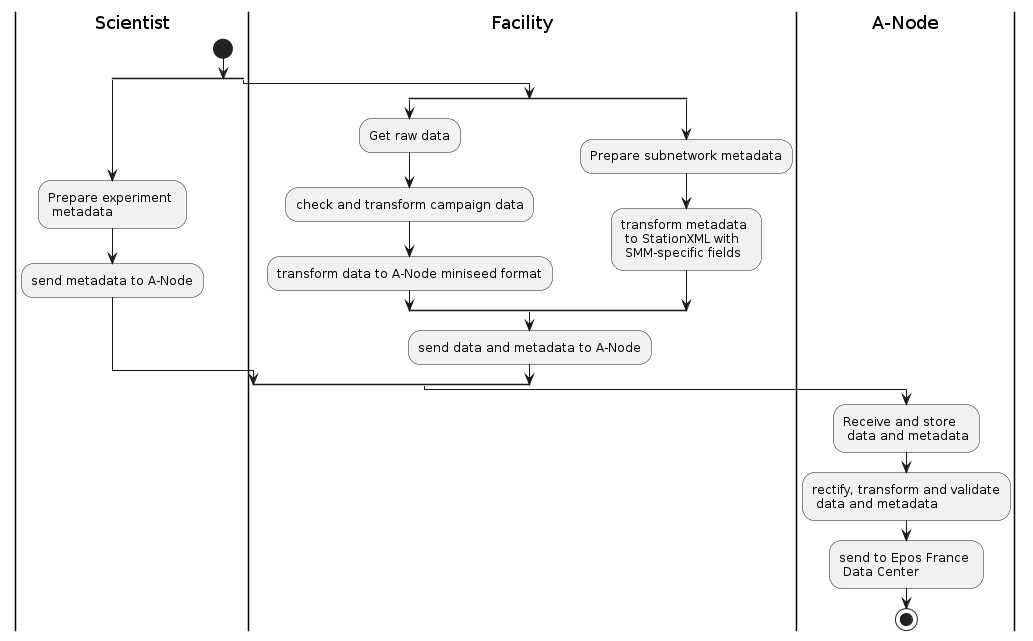
Figure Fig. 1.1 shows the relationships between the SMM A-Node,
instrumentation facilities and campaign scientists.
Fig. 1.1 Relationship between the SMM A-Node, Facilities, Scientists and the Epos-France Data Center
A ScientistProvider writes an Experiment metadata file, which covers all SubNetwork`s and
is updated at each data collection :ref:`Campaign.
For more information, see Scientist-Provided Metadata.
The A-Node receives this data and metadata, rectifies and transforms them, then prepares validation pages
for the Facilty and Scientist. More information for the technical auditor is at technical-web and for the scientific auditor at scientific-web.
Each processing step is performed by at least one specific tool, and the details should be saved in a
provenance file.
The tools used may be different from facility to facility, see Scientist: Experiment Metadata Processing and Facility Processing. Below are the steps performed at the A-node.
Before processing the data, the A-Node validates the consistency between data and metadata such as the network code, the number of stations and the station codes. It also validates the consistency between the Facility-provided Network information and that recorded by the FDSN. Further explanation can be found in the NodeA-Processing section